
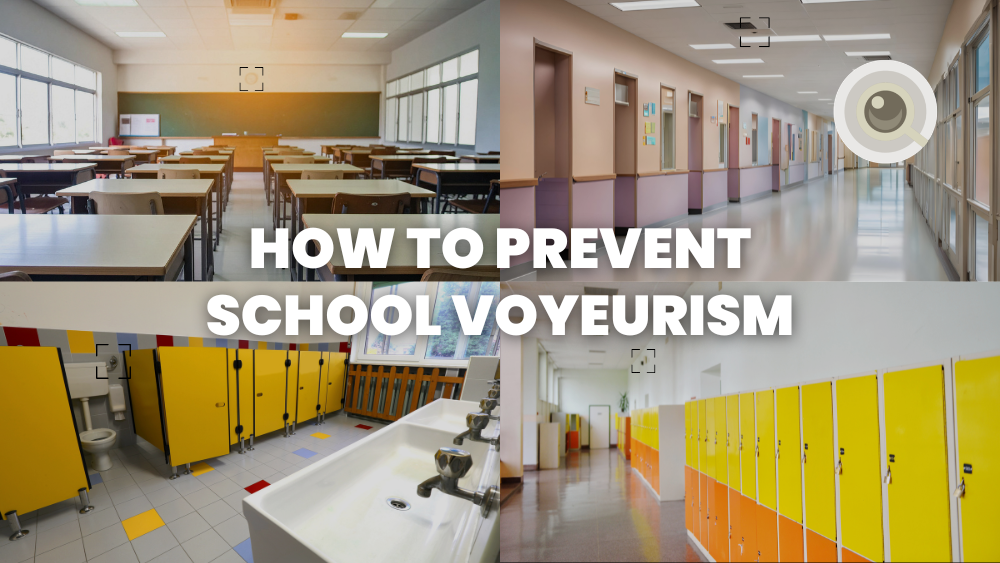
Preventing School Voyeurism: Safeguarding Bathrooms, Locker Rooms, & Private Campus Spaces
By: Admin
2026-07-30
Educational institutions hold a strict legal and moral duty of care to maintain physical safety and psychological security for students, staff, and visitors. While official CCTV systems effectively monitor campus perimeters, entrances, and corridors, they are strictly prohibited in private sanctuaries like restrooms, changing quarters, locker rooms, and nurse treatment areas.
Unfortunately, these mandatory "surveillance blind spots" create vulnerable opportunities for illicit covert recording devices. The proliferation of micro-pinhole lenses disguised as everyday items, smoke detectors, wall hooks, power outlets, and motion sensors has made covert voyeurism an urgent risk management priority for facility directors, health and safety teams, and campus security leads.
1. High-Risk Campus Zones: Mapping Privacy Vulnerabilities
To prevent unauthorized recording, safety officers must first identify areas where the expectation of privacy is highest and physical oversight is naturally limited.
HIGH-RISK SCHOOL PRIVACY ZONES
- Restrooms & Stalls — Toilet paper dispensers, ceiling vents & tiles, under-sink plumbing
- Athletic Locker Rooms — Coat hooks & benches, shower stalls & drains, ventilation grilles
- Single-Occupancy & Staff Areas — Faculty break rooms, nurse / health offices, performing arts dressing rooms
Key Vulnerability Points:
- Student & Faculty Restrooms: Micro-cameras are commonly concealed inside replacement tissue dispensers, ceiling air vents, or fake screw heads on partition stalls.
- Athletic Locker Rooms & Shower Facilities: Unmonitored changing alcoves, bench undersides, and wall hooks provide line-of-sight angles for hidden lenses.
- Visiting Team Changing Facilities: Frequently left unlocked or unattended between athletic matches, making them high-risk targets for unauthorized entry.
2. Recognizing Disguised Voyeurism Tech
Modern spy hardware rarely looks like a camera. Perpetrators utilize consumer electronics re-engineered with micro-pinhole lenses (often 1mm to 2mm in diameter) that operate completely offline without requiring active Wi-Fi or Bluetooth broadcasting.
- Pinhole Wall Hooks — Mounted on restroom doors or shower stalls. Appears as a standard utility hook; the recording module is built into the plastic casing.
- Fake Smoke / Motion Detectors — Ceiling corners directly above private stalls. High line-of-sight angle; often ignored as standard safety infrastructure.
- USB Wall Chargers & Power Strips — Low-level electrical outlets near changing benches. Functional power passthrough masks internal camera components and battery source.
- Digital Desk / Wall Clocks — Faculty break rooms or nurse triage areas. Tinted acrylic face conceals the camera lens and night-vision infrared (IR) LEDs.
3. Physical & Environmental Security Countermeasures
A comprehensive anti-voyeurism strategy combines physical design modifications, clear access control, and routine physical audits.
Physical Facility Hardening
- Standardize Fixtures: Replace hollow plastic coat hooks, tissue dispensers, and wall hardware with solid, tamper-proof stainless steel fixtures that leave zero internal cavity space for concealed electronics.
- Eliminate Unnecessary Concealment Points: Seal unused ceiling access tiles, minimize deep alcoves in changing quarters, and ensure shower stalls utilize shortened curtains or visible partitions.
- Control Corridor Entrances: While cameras inside changing areas are strictly illegal, installing visible HD CCTV coverage at hallway entryways records everyone entering and exiting sensitive zones.
4. Why Physical RF Sweepers Fail Against Modern Spy Tech
Historically, facilities relied on Radio Frequency (RF) bug detectors to sweep for hidden cameras. However, RF sweeping presents severe limitations in educational settings:
- Offline Recording Defeats RF Detectors: Most voyeuristic cameras record locally to internal micro-SD cards without transmitting any wireless signals (Wi-Fi, Cellular, or Bluetooth). RF sweepers will pass right over them without alerting.
- RF Interference on Campuses: Campus Wi-Fi networks, smart whiteboards, wireless access points, and student mobile devices flood the radio spectrum, causing constant false positives on RF equipment.
- High Cost & Training Friction: Commercial RF spectrum analyzers require specialized technical training that typical facility staff and evening custodial teams do not possess.
5. Routine Privacy Sweeps with AI Detection
To bridge the gap between manual visual inspection and expensive technical counter-surveillance (TCM), school safety teams are adopting AI Detection.
Integrating Detekcam into School Safety Routines
DETEKCAM redefines privacy with an advanced AI technology. With an exceptional Lens-to-Lens detection, Infrared Detection and Magnetic Wave Detection our application is focused on precision and reliability in detection of any spy cameras around.
- Camera Detection — Uses advanced algorithms to scan and identify hidden cameras in various places. This includes hotel rooms, public restrooms, and changing areas.
- Infrared Detection — With integrated infrared detection capabilities, DETEKCAM can identify hidden spy cameras even in low-light or dark environments with precision.
- Magnetic Waves Detection — Using an advanced magnetic wave detection technology. DETEKCAM detects concealed spy cameras or devices through detection of waves from the electronic devices.
6. Standard Operating Procedure: Discovering a Hidden Camera
If a staff member or student locates a suspected covert recording device during a routine sweep or visual audit:
- Do Not Touch or Remove the Device: Touching the hardware can compromise physical fingerprints, forensic evidence, or digital data logs.
- Isolate and Restrict Access: Immediately close and lock the restroom or changing facility to preserve the scene.
- Document the Evidence: Use a mobile device to take wide-angle photos of the room layout, followed by close-up photos of the concealed device in place.
- Notify Administration & Law Enforcement: Contact the school principal, campus legal counsel, and local law enforcement immediately. Hidden cameras in private facilities constitute serious criminal offenses.
Proactive Vigilance Safeguards Campus Trust
Protecting students and staff from covert voyeurism requires moving from reactive crisis management to proactive prevention. By hardening physical facilities, standardizing hardware, and equipping staff with fast optical scanning tools like Detekcam, educational institutions can maintain safe, private environments and protect their community's trust.
Copyright © 2024 Cybergram Pte Ltd (UEN: 202300863E) t/a DETEKCAM
